Interview
AI Is Not Magic: Machine Learning, Signals and the Future of iGaming
A conversation with Blask CEO Max Tesla on machine learning, market intelligence and how iGaming companies turn fragmented data into actionable decisions.
Max Tesla, CEO and co-founder of Blask, explains why AI is becoming infrastructure, how market signals shape decisions and why context matters more than dashboards.
Key Takeaways
- AI becomes infrastructure, not a feature
- External signals increasingly shape decisions
- Speed matters, but accuracy matters more
- Human oversight remains critical
- Data without context creates false confidence
Why Blask Was Built Around "Truth in Data"
C-lvl: Max, you started out as a developer with a passion for business process automation, and now you run a technology company in the iGaming industry. Tell us how Blask developed — what challenges did you face at the beginning, and how did you build the company into what it is today?
Max: Blask was born out of frustration. The iGaming industry loves the word "data", but for a long time it existed in a state of market myopia. There’s a lot of information, but it’s fragmented and often doesn’t answer the main question: what exactly is changing — and why?
At the beginning, the main challenges were structural.
The first was fragmentation. In offshore regions, brands often exist through mirrors, clones, and chains of domains. If you measure things by domain, you end up with a picture that looks confident but is actually inaccurate. That’s why from the start we took a different approach — measuring the brand rather than the domain, and consolidating its distributed presence into a single brand profile.
The second issue was trust in the numbers. The industry tends to be sceptical — not because that’s its nature, but because it’s been burned before. Metrics were often presented as arguments rather than as something that could actually be verified.
So we intentionally designed the system to show not only results, but also context, limitations, and signals of uncertainty.
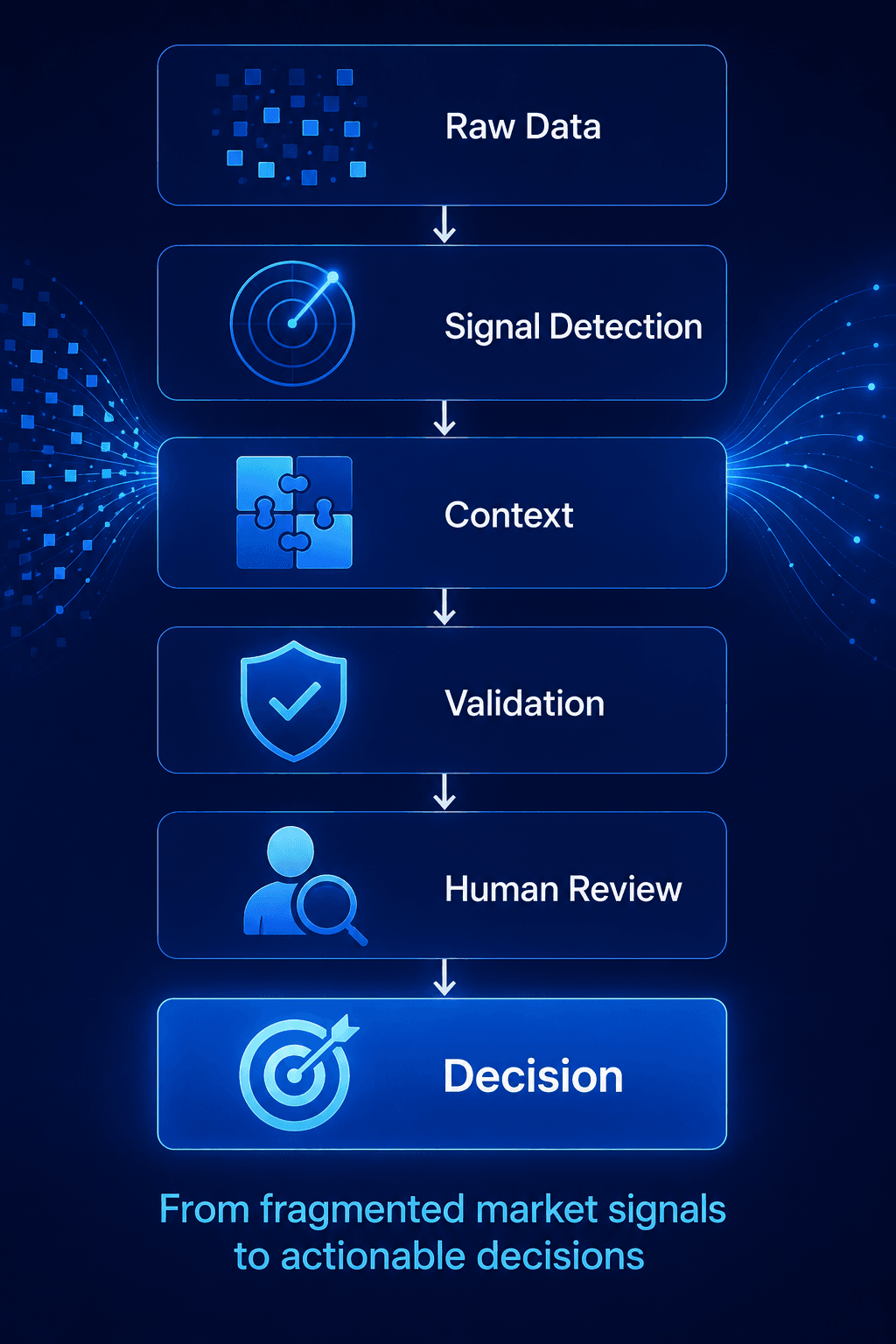
That’s why we built a quality control pipeline: normalization → brand identity deduplication → noise/intent filtering → anomaly detection relative to seasonality and competitive clusters → human triage for cases that might affect conclusions.
What helped us most was a very pragmatic philosophy: Truth in Data.
Not "let’s add AI because it’s trendy", but 'let’s create a unified and verifiable language for comparing markets.”
AI isn’t just an add-on for us — machine learning is part of the product’s DNA, simply because at the time it was the most efficient and cost-effective way to solve the industry’s real problems.
C-lvl: Which management principles do you think are the most effective for iGaming projects, especially those involving narrow expertise and rapid adaptation?
Max: There are a few principles that work almost every time:
1) Speed matters more than perfection, but accuracy matters more than beauty. You can work fast, but if the output is low quality, you’re simply producing mistakes faster.
2) There should be one shared reality for everyone. Inside a team there should be fewer opinions and more common benchmarks and definitions. If people argue about which dashboard is correct, it’s usually not a discussion — it’s a signal that the team doesn’t speak the same language.
3) Discipline in the details. iGaming isn’t a "more or less" industry. Regulation, seasonality, channels, payment methods, and local restrictions — any small detail can completely break a strategy.
4) A culture of saying "I don’t know". The most expensive mistakes often begin with the words: “Yes, everything is clear here.”
C-lvl: Today, technology and artificial intelligence influence not only internal processes but also corporate strategy. How do you think the iGaming industry is changing under the influence of AI, and which trends are shaping its future development?
Max: To be honest, I prefer the term machine learning. What people call AI is gradually moving from the category of a feature to the category of infrastructure.
Valery Babushkin (author of the Telegram channel @cryptovalerii and the book Machine Learning System Design: With End-to-End Examples) once made a good point: the Russian translation of AI is somewhat misleading because it changes the meaning of the concept.
In English, intelligence doesn’t only refer to the ability to think. It also means intelligence data — information that’s been collected, verified, connected, and turned into a basis for decision-making. In that sense, intelligence is closer to "a brief for action" than to IQ.
It’s no coincidence that one of the earliest texts on business intelligence — A Business Intelligence System — described intelligence as the ability to see relationships between facts that guide action toward a goal. The paper also discussed a communication system capable of delivering the right information to the right place quickly and efficiently, without manual overload.
In English, the word "artificial" most often means man-made or manufactured, not fake or false. In Russian, however, the word tends to carry the sense of something that only imitates the real thing. Because of that, people often get the impression that artificial intelligence is supposed to "think like a human".
But AI isn’t some magical "smart function". It’s closer to the next stage in the evolution of business intelligence — one where data preparation, insight discovery, and explanation are automated and embedded directly into decision-making platforms.
Its value isn’t in its “intelligence,” but in its ability to help companies work faster and more accurately when manual processing simply isn’t enough anymore.
The key trends I see shaping the industry are:
- A shift toward more operational market understanding. The industry moves too quickly to build strategy on data that arrives with a weekly or monthly delay.
- A transition from description to explanation. It’s no longer enough to know what grew. You need to understand why it grew and which factors were involved. What matters here isn’t beautiful dashboards, but causal layers and testable hypotheses.
- The growing role of outside-in signals. Internal metrics show what’s happening inside a product, but they don’t explain where attention and demand are shifting across the industry.
- Standardization of the language of comparison. The more global the market becomes, the more important it is to have comparable metrics that don’t depend on any specific operator’s internal systems.
C-lvl: Operators interest in AI solutions is growing rapidly. In your opinion, which areas of the iGaming industry couldn’t be developed without artificial intelligence?
Max: Honestly, the question isn’t whether AI is necessary anymore — it’s what you’re willing to leave at the level of human capacity, and at what cost.
I’d highlight five areas:
- External market signals. Seasonality, the sports calendar, regulatory changes, payment logistics, and the migration of demand between brands are simply too complex and too dynamic to track manually.
- Managing brand fragmentation in offshore GEOs. When a brand has dozens of mirrors and clones, domain-level logic can lead to incorrect conclusions. Consolidating everything into a single brand profile, separating trends from noise, and keeping it updated is a task machines handle much better.
- Interpretation rather than collection. The industry already has plenty of numbers. What’s missing is interpretation and prioritization: what actually matters, what’s accidental, and what’s repeatable.
- Data quality control and protection from manipulation. A healthy system should be able to detect anomalies and verify context — for example, boosted traffic, incentivized traffic, or artificially created spikes.
- Operations and marketing across multiple geographies. Without automation, the frequency of testing and rebuilding strategies across several countries becomes physically impossible.
C-lvl: Blask integrates OSINT, LLM and proprietary algorithms to create a unified analysis system. How can the balance be struck between automated data collection and verification, and in which cases is human involvement indispensable?
Max: We start from the simple premise that AI is a tool, not a responsible entity.
Our system builds metrics and comparisons and then identifies 'suspicious' cases, such as sharp jumps without seasonal context, inconsistencies with the demand structure and discrepancies with the competitive cluster, and flags them. Next, human triage kicks in, involving checking sources, events and changes on the brand/geo side. The decision is then recorded so that it becomes a learning signal for the system.
Human intervention is essential in situations where the cost of error is high, such as with new regulatory regimes, non-standard brand cases, controversial classifications and any situation where the conclusion influences strategic decisions.
C-lvl: AI is becoming more deeply integrated into iGaming processes—from data collection and analysis to marketing and product analytics. Which new directions do you think will become key for AI over the next two years? Where is the new “gold standard” for its application being formed today?
Max: Over the next two years, AI will be valued not for the fact that it can calculate more, but for the fact that it reduces uncertainty and increases manageability.
I’d highlight a few areas where a new standard will likely emerge:
- Causal analysis instead of reporting. Not just what happened, but why it happened, what’s connected, and which hypotheses should be tested next—with clear logic and stated limitations.
- Early detection of shifts in demand and attention. Companies won’t win by reacting faster. They’ll win by spotting trends while they’re still forming and acting ahead of the curve.
- Anti-fraud and signal integrity. Good AI doesn’t pretend it’s error-free. It builds control protocols: anomaly detection, signal structure comparison, and contextual validation.
- Closed decision loops. Detect a change → form a hypothesis → propose an action → measure the effect → adjust the rules. But the gold standard here isn’t full autonomy. It’s a smart division of roles: machines handle scale and iterations; humans set the boundaries, risks, and responsibility.
- Normalization of the outside-in view. Synchronizing the internal world (CRM/product) with the external one (market, demand, reputation, distribution) will become a baseline practice, not an “advanced capability.”
C-lvl: In the B2B segment, media presence is often seen as a secondary tool. But today it directly affects partnerships and brand perception. In your opinion, how should companies build their media image within a professional environment?
Max: In B2B, trust is often the first thing you sell. A strong product matters, but the way a company is perceived by clients, partners, and the market can directly influence deals, decision-making speed, and the cost of potential mistakes.
A media reputation is best built through precision rather than volume:
- speak when you have something meaningful to contribute;
- explain your methodology and reasoning;
- remain consistent, maintaining the same communication style in both favorable and challenging circumstances.
In fact, difficult moments often reveal a team’s true character more clearly than any announcement about growth or success. In my view, the industry benefits more from thoughtful, sustainable visibility than from publicity driven by hype.
For example, we recently discussed the implications of regulatory changes in Brazil with a local expert on the Sound & Noise by Blask podcast. I believe the conversation turned out to be both insightful and practical.
C-lvl: In your reports it’s clear how differently iGaming develops across various parts of the world. Which GEOs would you call the most promising today — and which metrics actually matter when assessing a region’s potential?
Max: The potential of a GEO can’t be measured by a single number. You need a combination of factors: demand dynamics, regulatory risks, payment infrastructure, the share of the grey market, competitive density, the broader economy, and the ability of demand to convert into real revenue.
If we talk about interest dynamics, some GEOs occasionally show explosive growth rates (something like 300–700% year-over-year). But that doesn’t automatically mean the market is becoming a gold mine — the base might be small, the average ticket low, and monetization complicated.
If we look at CEB (Competitive Earnings Baseline) — an estimate of the baseline potential, meaning how much revenue is theoretically available to a brand in a given country at a certain level of market demand and context — the largest “capacity” markets often measure in billions.
But after that, everything comes down to reality: regulation, monopolization, compliance requirements, and how accessible the market actually is for a specific brand.
C-lvl: Which stages of training and updating AI models do you consider most critical when it comes to practical business use? Where do companies most often make mistakes?
Max: The most critical stage is the data before the model: cleaning, normalization, noise control, and reproducibility. Without that, even the “smartest” model will make mistakes — just very confidently.
The next step is drift control. iGaming is highly sensitive to seasonality, sports events, and regulatory changes. A model that doesn’t track shifts in context starts making systematic errors.
The third element is the validation loop and quality monitoring: clear tests, anomaly alerts, and a defined rule for where the model can be wrong and where human oversight is required.
Typical mistakes companies make:
- "We have AI, so we must be smart". No — you’ve just acquired a tool.
- They confuse internal metrics with external reality and draw false conclusions.
- They don’t build verification protocols and don’t understand the limits of where the model actually applies.
C-lvl: How do approaches to working with partners differ across the CIS, Europe, and Asia? Which principles help build trust and long-term relationships?
Max: There are real differences in communication style. In the CIS, speed and flexibility tend to be valued more. In Europe, it’s process, compliance, and precision in wording. In Asia, context and long-term consistency often matter more.
But trust itself is built on the same foundations everywhere:
predictability,
methodological transparency,
a willingness to acknowledge limitations,
and the ability to stand behind results.
If you can explain how something works, show the reasoning behind it, avoid hiding weak points, and act consistently — relationships tend to become stable regardless of the region.
You can find more conversations with industry leaders on C-level, covering technology, strategy, and business transformation across different sectors.