Interview
How to Grow From Head to C-Level in iGaming — Insights From EvenBet HRD
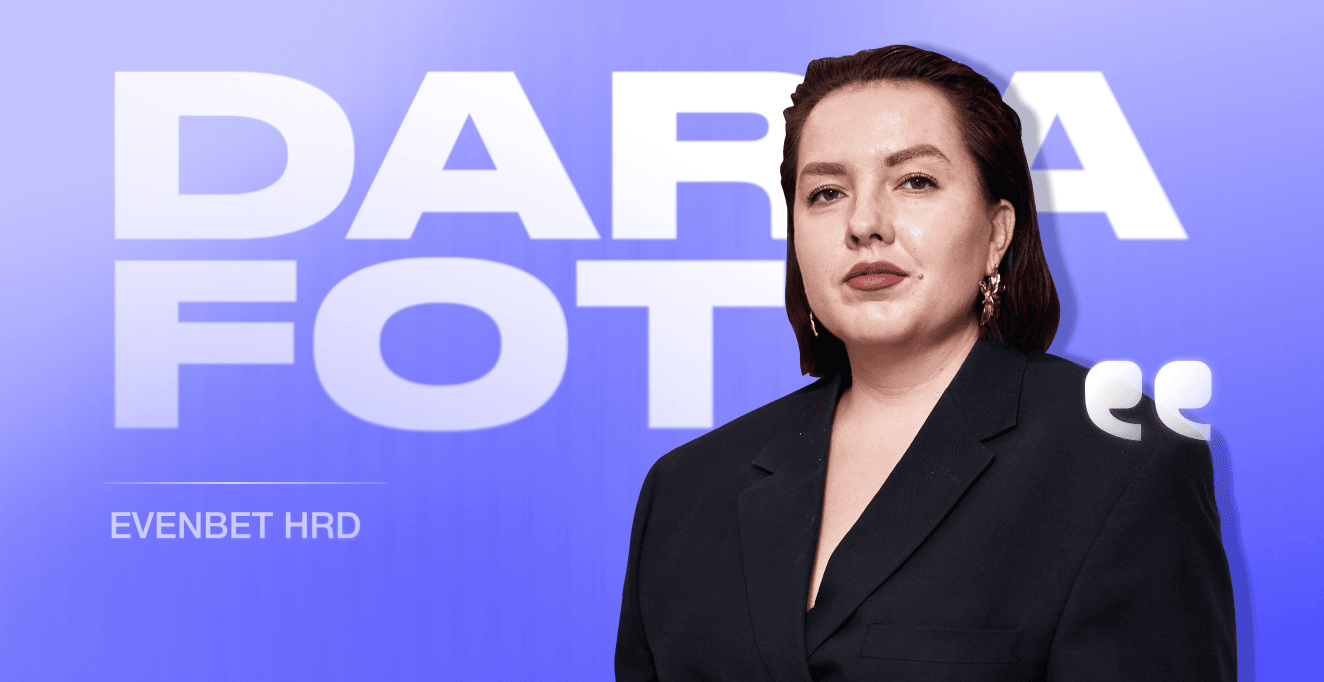
An interview with EvenBet HRD Daria Fot on leadership evolution, executive hiring and the skills needed to grow from Head to C-level.
Key Takeaways
- What Separates a Head From a C-Level Executive?
- Why Strong Heads Often Struggle to Reach C-Level
- Which Skills Are Missing Before the Transition?
- Can Leaders From Other Industries Succeed in iGaming?
- How EvenBet Approaches C-Level Hiring
- Red Flags in Executive Recruitment
- How AI Will Change Leadership Requirements
C-lvl: Where do you see the difference between a strong head of department and a C-level executive in iGaming?
Daria: The main difference between these two roles is how they work with the company's goals and strategy. The Head takes on the role of a high-performing individual: they build a plan to achieve goals and lead their team to results. The C-level is also involved in creating these goals. They don't just implement the strategy; they shape it. They think years ahead and bring ideas that can be pivotal for the business.
The number of people in charge and the structure of the team are also important, but these are secondary features. I've seen Heads with huge teams that have never outgrown their level. And vice versa. For me, though, it's not about the number of subordinates, but the scale of thinking.
C-lvl: Which competencies are most often 'out of reach' at Head level before moving to C-level? What usually prevents a strong head from reaching the senior management level?
Daria: The most common story is that the head does an excellent job with tasks and knows how to fulfil and exceed KPIs, but has never 'sat at the table' where these KPIs are created.
If an employee has done a great job in the Head position for 2-3 years, I believe it's worth involving them in other processes and giving them a chance to prove themselves in strategy formation. This will enable them to better understand how the C-level team works and learn from useful experience.
However, I see that most companies in the industry don't do that. It's easier to keep a strong head in a position where they are already producing results. Consequently, employees often leave to grow to C-level in another company.
C-lvl: What specific business results should a candidate demonstrate to qualify for a C-level position? What metrics, scale of responsibility and implemented cases are key to your assessment of a candidate's level and maturity?
Daria: It's always a combination of results in terms of goals, the scale of responsibility and, importantly, years of experience. The iGaming industry moves quickly, but it's impossible to "skip" all the levels and be successful in a C-level position in two years. There are stages that are important to go through, regardless of the industry.
I'll share an analogy that I often use. The head coach of a football team is responsible for the overall strategy, is aware of what the competition is doing, and can see the strengths and weaknesses of the whole team. The assistants, meanwhile, work in specific areas such as goalkeeping, defence and attack. This is the exact separation between the C-level and the Head.
Becoming a strong leader is a step-by-step process. First, you lead two to three employees, then you manage the department, and finally you become a cross-functional manager who sees the bigger picture. Personal maturity and the ability to process large amounts of information and make decisions in uncertain conditions only come with time.
My guiding principle is that if a Head has consistently achieved goals for several years, is proactive and offers ideas based on their own vision, they can already be considered C-level.
C-lvl: How important is experience in iGaming for this role? In which C-level roles would you consider candidates from other industries, and in which areas would a lack of iGaming experience pose a critical business risk?
Daria: I didn't come from iGaming myself — I worked in IT, but in a completely different field. As the past seven years have shown, however, my experience has proven to be relevant.
Over the past two years, we have successfully hired two C-level candidates from other industries. It's the fresh perspective and ideas from another field that can strengthen the company. In fact, you are buying someone else's industry experience.
Studying the specifics of the industry is not such a difficult task for a strong C-level as being an effective manager. What's much more important is how you make decisions, how you handle difficult tasks, and what kind of leader you are.
If we talk about specific roles: CFOs and COOs without iGaming experience can settle in more easily as these areas are quite versatile. However, a CMO or CPO without an understanding of the product and audience specifics is already risky. In these areas, the industry's nuances are critical from day one. Therefore, you cannot hire a completely new C-level team without iGaming experience. It's important to strike the right balance: some people must know the industry inside out, especially at performer level.
C-lvl: What does your C-level hiring process look like in practice? How many stages does a candidate usually go through, who participates in the assessment and who makes the final decision?
Daria: For each C-level position, the CEO and I create a separate roadmap. There is no universal template. We discuss the number of stages and whether it is necessary to introduce the candidate to the entire management team. The standard chain is recruiter/direct supervisor/CEO and I, the HRD. Plus, we always collect references from past jobs, from both colleagues and subordinates. If any ambiguous information appears in the references, we do not ignore it. We pay attention to red flags, even when we like the candidate. For example, we recently rejected a strong candidate precisely because of negative feedback from his former subordinates.
C-lvl: How can the risk of making an expensive mistake when hiring for C-level positions be reduced? What do you check especially carefully: reputation, recommendations, case studies, management style, cultural fit or something else?
Daria: By the time a candidate reaches me, their hard skills have already been evaluated by the head and CEO. My area of responsibility is soft skills and cultural fit.
I always ask, 'How would your staff describe you?' How would your colleagues describe you? What kind of manager do you consider yourself to be? Who would you consider to be a problematic employee?
The last question is my favourite. Some say: 'The one who doesn't fulfil KPIs', while others say: 'The one I couldn't help open up.' These responses paint different pictures of the world and accurately predict the kind of culture this candidate will foster. A red flag would be if a person said, 'I see a goal, I see no obstacles,' or 'a team is a tool to achieve a goal.' What we need is someone who can sell goals to the team, see people as individuals and understand their motives.
C-lvl: What are you willing to pay above the market rate for a C-level candidate? What qualities in a candidate would justify a high offer?
Daria: When a company has been around for a long time, it has a reputation and a culture. Strong C-levels want to work for such a company. In such situations, candidates are often willing to move up a little in salary for interesting projects and a good environment. It is relevant to pay above the market in two cases: when launching a new product or company, or when the internal culture is complex or underdeveloped — you are actually paying extra for your willingness to work in these conditions.
C-lvl: How will the requirements for C-level roles in iGaming change over the next two years? Which factors will have the greatest impact on business demand: regulation, new geographic areas, artificial intelligence, increased competition, cost pressure or team effectiveness?
Daria: AI, regulation and new GEOs are really changing the context. However, this is precisely why the demand for human skills will only grow. In an unstable external environment where tools change yearly, the only stabilising factor for a company is people who can think outside the box, adapt and lead. As an HRD and an Executive Coach working with C-level executives, I see this demand for competent management and modern leadership growing dramatically. This has led me, among other things, to start the Telegram channel 'Romance with Personnel', in which I write about teamwork, leadership skills, and relevant research analysis.
Let's be honest: people's psychology doesn't change — and this gives a competitive advantage to those in the top management tier who understand this.
You can find more conversations with industry leaders on C-level, covering technology, strategy, and business transformation across different sectors.