Business
Hiring an iGaming CEO Is Not Just a Talent Problem
This article explains why hiring a CEO in iGaming is more complex than a typical executive search, from regulation and reputation to board politics and compensation.

Hiring an iGaming CEO Is Not Just a Talent Problem
Key Takeaways
- Hiring a CEO in iGaming is not just a recruitment process — it is a strategic risk event.
- The biggest challenge in executive hiring is often board alignment, not talent availability.
- Long hiring processes are frequently caused by unclear priorities, changing expectations and internal decision-making issues.
- “Unicorn briefs” slow down searches by combining unrealistic expectations into a single executive profile.
- In iGaming, reputation and informal market perception often influence hiring long before formal references begin.
- A CEO appointment should be measured by long-term outcomes, not by the announcement itself.
The public version of a CEO transition is always neat: a short announcement, a few lines about continuity, a polite quote from the chair, and a start date. From the outside, it can look almost frictionless. Inside the business, it rarely is.
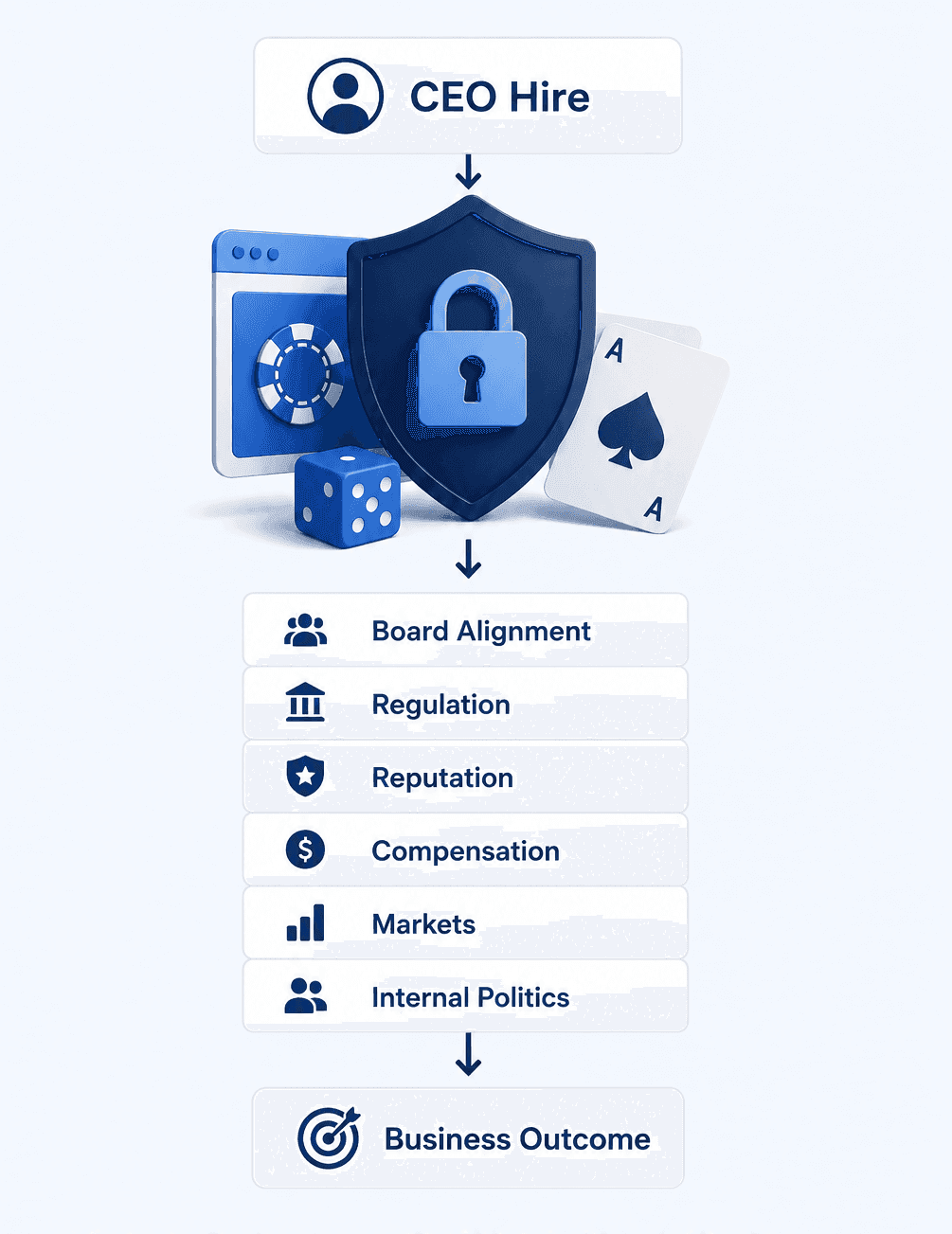
In iGaming, a CEO hire is not just a senior appointment. It is a strategic risk event. Regulation, investor confidence, internal power balance, licensing exposure, and market timing all sit inside the same process. That is why the hardest part of replacing a CEO is usually not finding talent. It is getting the board aligned on what problem the next leader is actually there to solve.
The search starts before the search
One of the clearest points in recent reporting on CEO hiring in iGaming is this: the process begins long before the market sees it. By the time a formal search starts, the real work should already be underway: defining the mandate, testing internal alignment, and deciding what the next CEO is meant to fix, build, or protect.
That sounds obvious. It often is not.
Boards like to say they are hiring for growth, transformation, market expansion, or operational maturity. In practice, many searches begin with a much blurrier brief: someone strategic, commercially strong, regulator-friendly, internationally credible, culturally perfect, and ready to move fast. That is not a mandate, that is a fantasy profile.
If the board cannot agree on the company’s next chapter, it will not agree on the leader for it either.
Most hiring delays are self-inflicted
The industry tends to talk about senior hiring as if the main bottleneck were talent scarcity. Sometimes it is. More often, the drag comes from the employer side.
Long executive searches are frequently described as a shortage problem. In reality, they are often a discipline problem: unclear priorities, too many decision-makers, changing criteria, inconsistent availability, compensation that does not match the brief, or internal disagreement disguised as due process.
The search is not usually lost because no strong candidates exist. It is lost because the company keeps redrawing the map while the process is already moving.
Once that happens, every round gets slower, every opinion gets heavier, and every candidate starts reading the same signal: the board does not know what it wants.
The 'unicorn brief' is still wasting everyone’s time
There is another familiar pattern in executive hiring: the search for the impossible candidate.
The industry still writes briefs as if one person should combine deep licensing knowledge, cross-market operating experience, technical fluency, product instinct, cultural fit, investor polish, and founder-level energy. Then it tries to hire that person within the budget of a far less ambitious role. This is where many searches quietly stall.
The market does not reward vague ambition. It rewards precision. A board that knows whether it needs a stabiliser, a scaler, a market-entry operator, a regulator-safe pair of hands, or a transformation CEO will move faster than one still searching for a mythological all-rounder.
The more complex the business, the less useful the unicorn brief becomes.
In iGaming, reputation enters the room early
Another difference between iGaming and many other sectors is how early due diligence starts. Formal references come later. Informal reputation mapping starts almost immediately.
That is partly structural. iGaming remains a networked industry with short lines between operators, platforms, advisors, recruiters, and regulators. Senior candidates rarely arrive as blank profiles. They arrive with a market memory attached to them. Sometimes that helps. Sometimes it quietly ends the process before it properly begins.
This changes the character of executive hiring. Boards are not only evaluating capability. They are evaluating reputational safety, licensing comfort, stakeholder reaction, and whether the appointment creates confidence or friction before day one.
That makes discretion more important, but it also makes the process less linear than many boards expect.
A CEO hire is now a cross-border risk calculation
The complexity rises further when geography enters the equation.
In iGaming, jurisdiction is no longer a side note in executive hiring. It can shape the entire brief. A leader who looks ideal for one market may be unusable in another.
Regulatory background, local residency requirements, tax exposure, licensing history, and product familiarity now affect the shortlist much earlier than they used to.
That matters because the map is moving. Brazil has changed the operating logic for senior hires. The UAE has created leadership opportunities that barely existed in most board discussions a few years ago. New markets do create growth plans and change what counts as a credible executive profile.
As a result, boards are no longer looking only for strategic range. They increasingly want leaders who can operate across regulatory systems, understand how technology is changing the business, and still maintain internal coherence at scale.
The real test comes after the announcement
A signed contract is not the finish line. It is the start of the proof.
Research on executive transitions consistently shows that more than 30% of senior leaders struggle or fail within their first 18 months in a new role. The reasons are rarely linked to capability alone. More often, they involve unclear expectations, stakeholder misalignment and difficulties adapting to a new environment.
Public markets, investors, and internal stakeholders often react to CEO appointments as if the hiring decision itself were the result. It is not. At best, it is an informed bet.
A strong executive hire should not be judged on announcement day.
This challenge is not unique to iGaming. Executive transition research shows that over 30% of senior leaders struggle during their first 18 months, often due to unclear mandates and alignment issues rather than a lack of experience.
It should be judged much later: once the leader has survived the handover, passed the internal resistance phase, established credibility with the board, and moved the business toward the objective they were brought in to deliver.
That is the right time horizon. Not the press release. Not the first 90 days. Something closer to the three-year mark.
Anything shorter flatters the process and tells you very little.
What boards keep getting wrong
The hidden complexity of CEO hiring in iGaming is not really hidden. It is just often misdescribed.
This is not mainly a recruitment challenge. It is not even primarily a talent challenge. It is a board-alignment challenge, complicated by regulation, reputation, geography, compensation discipline, and the sector’s tendency to ask one executive to solve too many problems at once. That is why some searches move quickly and others drag for months. Not because the market suddenly ran out of credible leaders, but because one company knew exactly what it needed and the other did not.
In iGaming, that is rarely a small detail. It is the difference between a succession plan and a boardroom struggle with a shortlist attached.
FAQ
- Why is hiring a CEO in iGaming more complex than in other industries?
CEO hiring in iGaming involves more than talent selection. Regulation, licensing, investor expectations, reputation and board alignment can all influence the process long before a candidate is hired.
- What causes most delays in executive hiring?
Many delays come from internal issues rather than a lack of candidates. Unclear priorities, changing requirements and disagreement between stakeholders often slow the process.
- What is a 'unicorn brief' in executive hiring?
A unicorn brief describes an unrealistic candidate profile that combines too many expectations into one role — from regulatory expertise to technical knowledge and founder-level leadership.
- Why does reputation matter so much in iGaming leadership hiring?
iGaming is a highly networked industry where informal reputation checks often begin before formal interviews and references.
- When should a CEO hire be considered successful?
A CEO appointment should be evaluated over a longer period, once the executive has completed the transition phase and delivered against the original business mandate.